TE²A methodology

Techno-Economic & Environmental Assessment: a structured methodology developed to evaluate the technical performance and economic feasibility of industrial processes or an entire value chain, particularly in decarbonization and energy transition projects.

Let's discuss your needs

TE²A (Techno-Economic & Environmental Assessment) is a structured methodology developed by Ekium to evaluate the technical performance and economic feasibility of industrial processes or an entire value chain, particularly in decarbonization and energy transition projects.

This approach combines process modeling, material and energy balances, equipment sizing, estimates of capital (CAPEX) and operating (OPEX) costs, and financial analysis to determine a project’s viability.

TE²A relies on recognized simulation tools (Aspen HYSYS, Aspen Plus) and ensures consistency, traceability, and comparability of the studies conducted within Ekium.
TE²A methodology objectives

  • Provide a clear and structured methodology for conducting technical and economic studies during the preliminary phase

  • Facilitate comparisons between different technologies and configurations (technical, economic, and environmental performance)

  • Support decision-making during the feasibility and preliminary design phases through standardized analyses (CAPEX, OPEX, LCOX, CO₂ balance)

Our strengths

  • Structured methodology: a comprehensive workflow from data collection to the generation of the final report, including a digital tool

  • Proven industrial tools: use of Aspen HYSYS (hydrocarbons, gas, biogas, LNG, CO₂, H₂) and Aspen Plus (electrolyzers, non-ideal chemistry, e-fuels, solids, CO₂)

  • Multi-criteria approach: simultaneous evaluation of technical, economic, and environmental performance

  • Standardization: Ensuring consistency and comparability across studies through a common methodological framework

  • Flexibility: Adaptation to available data (robust or preliminary) and the required level of detail

  • Integrated database: access to the DECARB Database for technology data and cost references

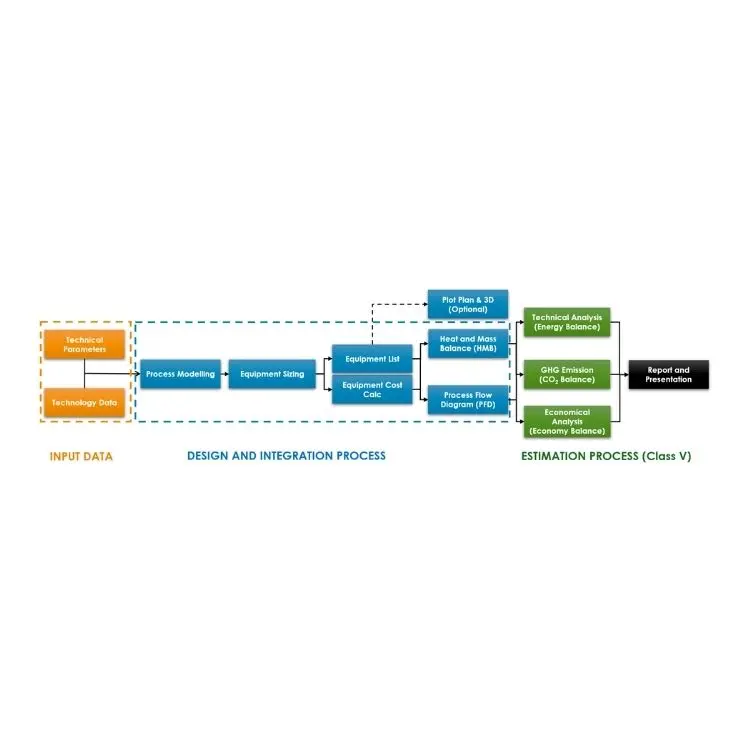
TE²A main workflow

1. Input data

Collection of technical and economic parameters:

Basis of Design: scale, product/feedstock specifications, battery limits

Technical assumptions: selected technologies, operating conditions, supplier/literature data

Economic assumptions: lifespan, market prices, financial criteria, cost methodology

2. Process modeling

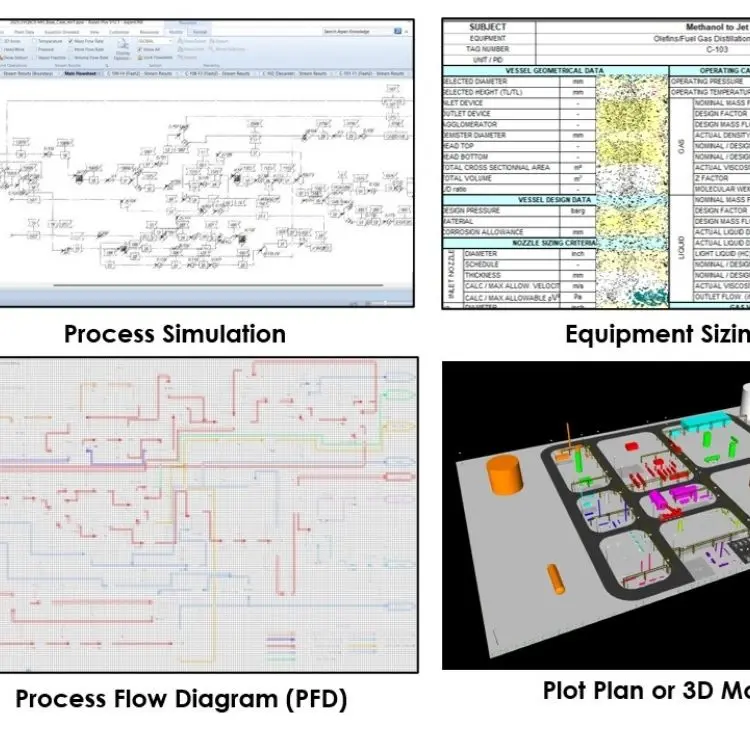
Development in Aspen HYSYS (hydrocarbons, gas, biogas, LNG, CO₂, H₂) and Aspen Plus (electrolyzers, non-ideal chemistry, e-fuels, solids, CO₂):

  • Flowsheet design and thermodynamic/reaction setup

  • Validation of material and energy balances

  • Energy optimization (recovery, thermal integration)

  • Output: detailed balances (HMB), equipment list, sizing data

3. Sizing and cost estimates

Equipment Sizing: heat exchangers (Aspen EDR), columns, reactors, pumps/compressors, auxiliary equipment

CAPEX (AACE Class V or IV): equipment, installation, engineering, contingencies

OPEX: raw materials, utilities, maintenance, personnel

LCOX: Levelized Cost of Production

4. Analysis and deliverables

Assessments: energy, GHG (CO₂), economic

Diagrams: PFD, BFD, Plot Plan (optional)

Standardized report: technical and economic summary, key indicators, recommendations

Tools

  • Software: Aspen HYSYS, Aspen Plus, Aspen EDR, Visio

  • Database: DECARB Database (technologies, costs)

  • Application: TE2A DIGITALIZATION TOOLS

  • Typical team: 1 Technical Manager, 1 Process Engineer, 1 Mechanical Engineer, 1 Costing Engineer

EKIUM
With TE2A, we are able to objectively compare different technologies and configurations across a process or a complete value chain, guaranteeing consistency and traceability. Our digital tool guarantees reliable data and consistent comparisons, while reducing study time.
Valentin
Innovation Leader